Peer Review Policy

The Indo-Eurasian Journal of Thermal Engineering and Materials Science (IJTEMS) maintains the highest standards of scientific rigor. We strictly adhere to a Double-Blind Peer Review process to ensure impartial, objective, and fair assessment of all submitted manuscripts.

In this model, the identities of the authors are concealed from the reviewers, and the identities of the reviewers are concealed from the authors throughout the review process.

1. The Review Process Flow

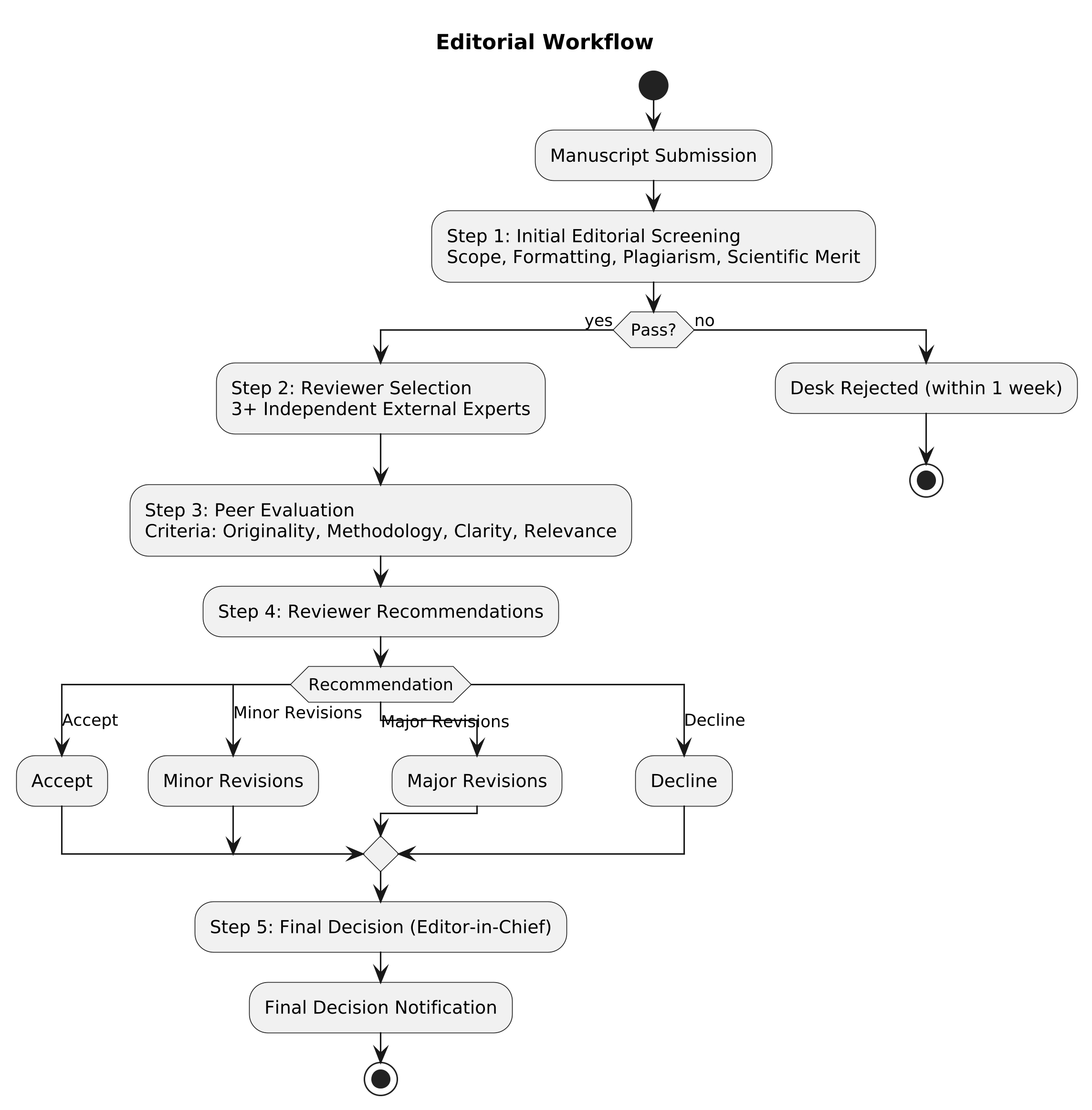
Step 1: Initial Editorial Screening (Desk Review) Upon submission, the Editor-in-Chief or a designated Associate Editor performs a preliminary check to ensure the manuscript:

  • Fits within the scope of the journal (Thermal Engineering or Materials Science).

  • Adheres to the journal’s formatting and ethical guidelines.

  • Passes the plagiarism check (using Turnitin/iThenticate).

  • Possesses sufficient scientific merit for formal review.

  • Outcome: Manuscripts failing this stage are Desk Rejected (usually within 1 week).

Step 2: Reviewer Selection Manuscripts passing the initial screening are assigned to at least three independent, external experts in the specific field of the paper.

  • Reviewers are selected based on their expertise, reputation, and lack of conflict of interest.

  • The journal avoids selecting reviewers from the same institution as the authors.

Step 3: Peer Evaluation Reviewers assess the manuscript based on the following criteria:

  • Originality: Is the research novel? Does it add to existing knowledge?

  • Methodology: Are the methods rigorous, reproducible, and technically sound?

  • Clarity: Is the writing clear, logical, and structurally sound?

  • Relevance: Is the topic significant to the thermal engineering or materials science community?

Step 4: Decision Making Reviewers provide a recommendation to the Editor:

  1. Accept Submission: No changes required.

  2. Minor Revisions: Small changes required (formatting, clarification).

  3. Major Revisions: Significant flaws or gaps in data/theory that require re-work.

  4. Decline Submission: The paper is scientifically flawed or lacks novelty.

Step 5: Final Decision The final decision lies solely with the Editor-in-Chief, based on the reviewers' reports. The Editor is not bound by the majority vote but by the strength of the scientific arguments provided.


2. Timeline Targets

We understand that timely publication is critical for researchers. IJTEMS strives to adhere to the following timeline:

  • Initial Screening: 1 week

  • Review Process: 4–8 weeks

  • Revision Period (for authors): 2–4 weeks (depending on revision level)

  • Final Decision: 2 weeks after revision submission

  • Online Publication: Immediately upon final acceptance and typesetting.


3. Reviewer Conflict of Interest

Reviewers must declare any potential conflict of interest before accepting a review invitation. Conflicts may include:

  • Having a personal relationship with the author.

  • Direct financial interest in the research outcome.

  • Recent collaboration (within the last 3 years) with the author. If a conflict exists, the reviewer must decline, and a new reviewer will be assigned.


4. Editorial Conflicts of Interest

To ensure absolute transparency:

  • Editors as Authors: If an Editorial Board member submits a paper to IJTEMS, they are completely suspended from the review process of that paper. The manuscript is handled by another independent editor, and the author-editor has no access to the reviewer details or decision-making process.

5. Appeals

Authors have the right to appeal a rejection decision if they believe there has been a significant misunderstanding of the scientific content. Appeals must be sent to the Editor-in-Chief with a detailed rebuttal. The Editor’s decision on the appeal is final.